


Choose the Right Network & Data Center Partner Now, Before Competitors Do

Every modern business depends on its network. Cloud applications, remote work, video conferencing, payment systems, customer portals, and AI workloads all run on infrastructure that must be fast, secure, and always available. When that foundation is weak, the result is downtime, security breaches, slow performance, and lost revenue.
That is why choosing among the top network infrastructure companies and top data center consultants is one of the most important technology decisions a business can make. The right partner gives you a scalable, secure, future-ready environment. The wrong one leaves you with hidden costs, vendor lock-in, and a network that cannot keep up with growth.
This guide explains what these companies and consultants actually do, why the decision matters, which criteria separate leaders from average providers, and how to run a selection process that protects your investment.
Why Network Infrastructure and Data Center Strategy Matter More Than Ever
A decade ago, network infrastructure meant cables, switches, and a server room. Today it includes:
- Wired and wireless enterprise networks
- Software-defined networking (SDN) and SD-WAN
- On-premises, colocation, and hybrid data centers
- Network security systems such as firewalls, intrusion prevention, and zero-trust access
- Cloud connectivity and multi-cloud architecture
- Monitoring, automation, and managed services
Several trends are raising the stakes:
1. Data growth. Businesses generate and store more data every year. Networks and data centers must handle larger volumes with low latency.
2. Hybrid and remote work. Employees now connect from homes, branch offices, and mobile devices. Secure, consistent access is essential.
3. Rising cyber threats. Ransomware, phishing, and targeted attacks mean security must be built into the network design, not added later.
4. Cloud and AI adoption. Cloud platforms and AI workloads demand high bandwidth, strong compute, and efficient power and cooling.
5. Compliance pressure. Industries such as finance, healthcare, and government face strict data protection and audit requirements.
Under these pressures, the quality of your technology partner directly affects your uptime, security posture, and ability to grow.
What Do Top Network Infrastructure Companies Do?
Top network infrastructure companies design, supply, deploy, and support the systems that connect people, devices, and applications. Their services typically include:
Network design and architecture
They assess your current environment and design a topology that meets your performance, security, and scalability goals, covering LAN, WAN, wireless, and data center fabrics.
Hardware and software supply
They provide switches, routers, access points, firewalls, load balancers, and controllers, and often hold certified partnerships with leading technology manufacturers.
Installation and implementation
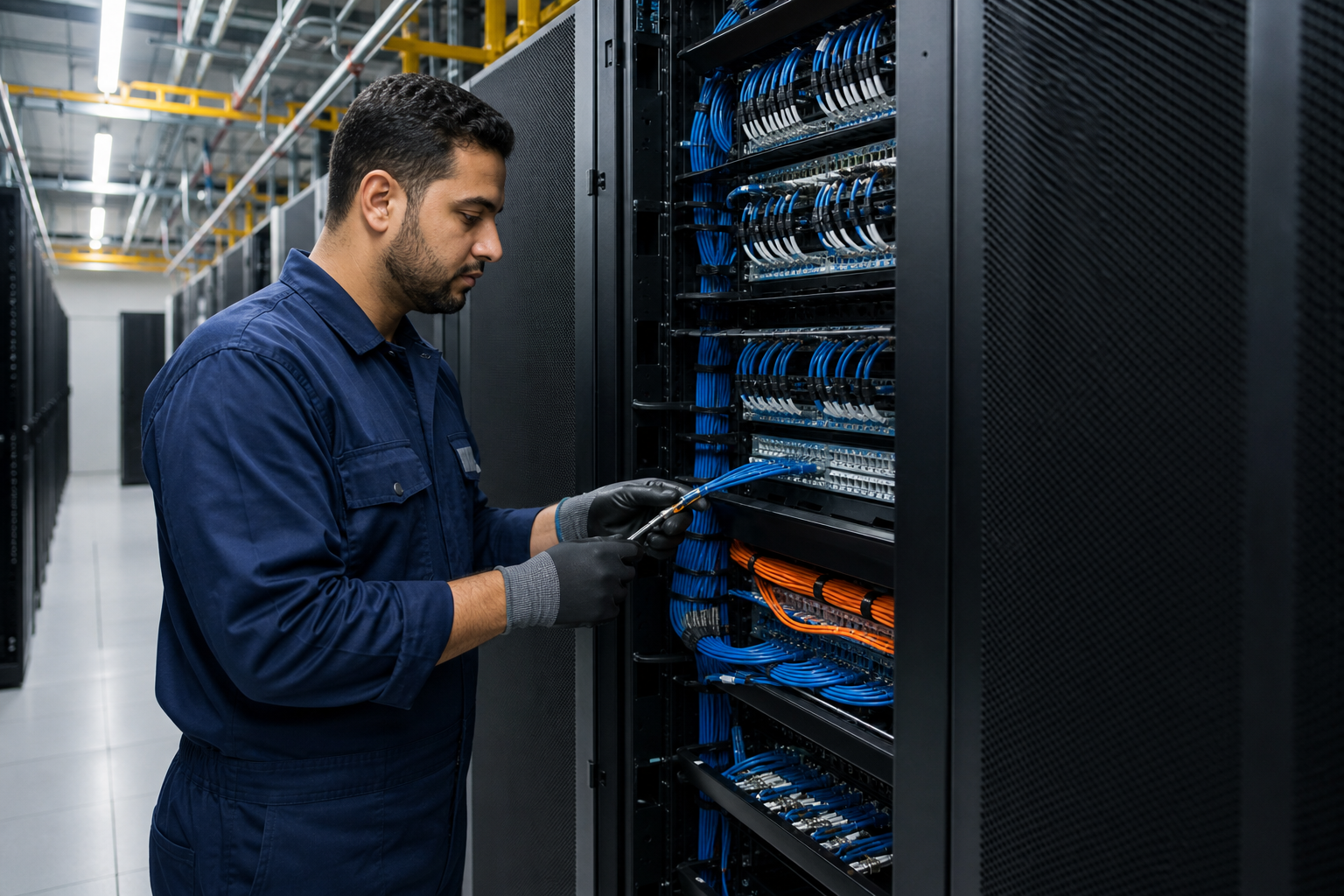
This includes structured cabling, rack and stack, configuration, testing, and documentation. Poor implementation causes a large share of network problems, so execution quality matters as much as design.
Network security systems
Leading providers integrate security into the infrastructure itself, including next-generation firewalls, network access control, segmentation, VPNs, endpoint protection, and threat monitoring. You can explore an example of an integrated approach on our network security system page.
Managed services and support
Many companies offer 24/7 monitoring, patching, performance optimization, and incident response, so your internal team can focus on strategic work.
What Do Top Data Center Consultants Do?
If network infrastructure companies build the roads, top data center consultants plan the city. They provide independent, strategic guidance on how your data center environment should be designed, built, migrated, and operated.
Assessment and strategy
Consultants evaluate your workloads, capacity, costs, risks, and business goals. They help you decide what should stay on-premises, move to colocation, or shift to the cloud.
Data center design and build planning
This covers power and cooling design, rack layout, redundancy (N+1, 2N), tier classification, physical security, and energy efficiency.
Migration and consolidation
Moving workloads between data centers or into the cloud is risky. Experienced consultants plan the sequence, test thoroughly, and minimize downtime.
Disaster recovery and business continuity
They design backup, replication, and failover strategies, then test them against realistic failure scenarios.
Compliance and risk management
They help align your environment with standards such as ISO 27001, SOC 2, PCI DSS, and local data regulations.
Cost optimization
Consultants identify underused capacity, inefficient power use, and licensing waste, often saving more than their fees.
Network Infrastructure Company vs. Data Center Consultant: Which Do You Need?
Many organizations need both, but at different stages.
| Situation | Best Fit |
|---|---|
| You need hardware, installation, and ongoing support | Network infrastructure company |
| You need an independent strategy before committing to vendors | Data center consultant |
| You are planning a data center build, relocation, or cloud migration | Data center consultant first, then an implementation partner |
| You need to upgrade or secure an existing network | Network infrastructure company |
| You want one accountable partner from strategy to support | A provider offering consulting plus implementation |
The strongest providers combine both capabilities. They advise honestly, design properly, and deliver what they promise, which reduces handoff risk between separate vendors.
10 Criteria for Evaluating the Top Network Infrastructure Companies and Data Center Consultants
When comparing providers, look beyond brochures and price quotes. These ten factors separate truly capable partners from the rest.
1. Proven experience and track record
Ask how many years they have operated and how many projects like yours they have completed. Request case studies, references, and measurable outcomes such as uptime improvements, performance gains, or cost reductions. Experience in your industry is a major advantage because it brings familiarity with your compliance and operational needs.
2. Technical certifications and partnerships
Look for certified engineers and official partnerships with recognized technology vendors. Certifications show a provider has met training and quality standards. Ask about the certification levels of the people who will actually work on your project, not just the company overall.
3. Security-first approach
Security should be part of the design from day one. A top provider will discuss segmentation, zero-trust principles, access control, encryption, logging, and incident response during the first conversation. If security only comes up as an optional add-on, treat that as a warning sign.
4. Scalability and future readiness
Your network should support the business you will be in three to five years from now. Ask how the proposed design handles growth, higher bandwidth, new locations, IoT devices, and emerging technologies like AI and edge computing. Avoid designs that need a full rebuild with every expansion.
5. Vendor neutrality and transparency
Consultants in particular should recommend what fits your needs, not what earns the biggest commission. Ask how they choose vendors, whether they receive incentives, and whether they will present multiple options with honest trade-offs.
6. End-to-end capability
A provider that covers assessment, design, deployment, and support avoids the finger-pointing that happens when several vendors share responsibility. Even if you only need one service now, a partner with full-lifecycle capability can grow with you.
7. Service levels and support quality
Review the support model carefully. Key questions include:
- What are the guaranteed response and resolution times?
- Is support available 24/7?
- Who handles escalations?
- Are spare parts and replacement hardware readily available?
- Is support delivered by local engineers or a distant call center?
8. Project management and communication
Good technology can still fail through poor execution. Look for a clear project plan, defined milestones, regular status updates, risk tracking, and complete documentation at handover.
9. Pricing clarity and total cost of ownership
The cheapest quote is rarely the cheapest outcome. Compare total cost of ownership, including licensing, support contracts, power consumption, maintenance, upgrades, and the cost of potential downtime. Insist on itemized proposals so nothing is hidden.
10. Reputation and client feedback
Check independent reviews, client testimonials, and industry recognition. Speak directly with at least two or three current or past clients, and ask what went wrong and how the provider responded, since how a company handles problems reveals more than how it handles smooth projects.
Red Flags to Watch Out For
Even strong-looking providers can be a poor fit. Be cautious if you notice:
- Vague proposals with no clear scope, timelines, or deliverables
- Pressure tactics that push you to sign quickly
- No references or reluctance to share past client contacts
- One-size-fits-all solutions offered without a proper assessment
- Proprietary lock-in that makes switching providers difficult or expensive
- Weak security discussion or treating compliance as an afterthought
- High staff turnover or an inability to name the engineers who will do the work
- Unrealistic promises, such as guaranteed 100% uptime with no redundancy in the design
Step-by-Step Process to Choose the Right Technology Partner
A structured process removes guesswork and protects you from emotional or rushed decisions.
Step 1: Define your business goals
Start with outcomes, not products. Are you trying to reduce downtime, support remote work, prepare for a cloud migration, improve security, or cut operating costs? Clear goals make every later decision easier.
Step 2: Document your current environment
Gather information about your existing network topology, hardware age, data center capacity, security tools, applications, and known pain points. Even an incomplete inventory helps providers give accurate proposals.
Step 3: Set requirements and budget
List must-have and nice-to-have requirements covering performance, security, compliance, availability, and support. Set a realistic budget range that includes ongoing costs, not just the initial purchase.
Step 4: Build a shortlist
Identify three to five candidates through referrals, industry research, and vendor partner directories. Review their websites, certifications, and published case studies.
Step 5: Issue a request for proposal (RFP)
Send every shortlisted provider the same requirements document so proposals can be compared fairly. Ask them to address design approach, timeline, team, pricing, support, risk management, and references.
Step 6: Evaluate with a scorecard
Score each provider against weighted criteria such as technical fit, security, experience, support, and cost. A scorecard keeps the decision objective and gives you a defensible record.
Step 7: Run discovery sessions or a pilot
Ask finalists to present their design in a workshop or run a small proof of concept. Pay attention to how well they listen, how they handle tough questions, and whether their engineers are as strong as their sales team.
Step 8: Check references and negotiate
Contact references and verify claims. Then negotiate scope, service levels, penalties for missed targets, exit terms, and pricing before signing.
Step 9: Plan the transition
Agree on a rollout plan with milestones, testing, rollback options, training, and documentation. A phased approach lowers risk and builds confidence.
Step 10: Review performance regularly
Schedule quarterly reviews to measure uptime, incident response times, and progress against goals. A good partner welcomes accountability.
Questions to Ask Before You Sign
Use these questions in your meetings to quickly gauge quality:
- Can you show similar projects you have completed for organizations of our size and industry?
- Who will be on our project team, and what are their qualifications?
- How will you build security and compliance into the design?
- What happens if something fails during migration or cutover?
- What are your guaranteed response times, and what remedies apply if you miss them?
- How do you handle documentation and knowledge transfer?
- What are the full ongoing costs over three to five years?
- If we decide to leave, how easily can we take over or transfer the environment?
- How do you stay current with new technologies and threats?
- Can we speak with three clients who have worked with you for more than two years?
The answers will reveal both competence and honesty.
The Role of Network Security in Choosing Your Partner
Security deserves special attention because infrastructure and security are now inseparable. A well-designed network limits the damage of any single breach through segmentation, strict access policies, continuous monitoring, and rapid detection.
When evaluating providers, confirm that they can deliver:
- Next-generation firewalls and intrusion prevention to inspect and block malicious traffic
- Network segmentation to separate sensitive systems from general traffic
- Zero-trust access controls that verify every user and device
- Secure remote access for distributed teams
- Centralized logging and monitoring for visibility and compliance
- Incident response planning so you know exactly what happens during an attack
Providers who treat security as a core part of network design deliver far better protection than those who bolt it on afterward. To see how an integrated network security approach looks in practice, visit Nectar Limited’s Network Security System solutions.
Common Mistakes Businesses Make When Choosing a Provider
Choosing on price alone. Low bids often leave out essential items that appear later as change orders.
Skipping the assessment. Without a proper audit, designs rely on assumptions, and assumptions cause failures.
Ignoring growth. A network built only for today’s needs becomes a bottleneck within a year or two.
Overlooking support. Excellent installation means little if no one answers the phone during an outage.
Not involving internal teams. Your IT staff understand daily operations. Excluding them leads to poor adoption and missed requirements.
Failing to plan for exit. Contracts should clearly state ownership of documentation, configurations, and data if the relationship ends.
Neglecting testing. Disaster recovery plans that were never tested often fail when needed most.
Emerging Trends to Consider
A forward-looking partner should be comfortable with the trends shaping the next generation of infrastructure:
- Hybrid and multi-cloud networking, connecting on-premises systems securely to multiple cloud providers
- SD-WAN and SASE, which simplify branch connectivity while strengthening security
- Automation and AIOps, using analytics to predict failures and automate routine tasks
- Edge computing, placing processing power closer to users and devices
- Sustainable data centers, with efficient cooling, renewable energy, and better power usage effectiveness
- High-density computing, supporting AI and machine learning workloads with advanced power and cooling
Ask potential partners how they are preparing for these shifts and how they would apply them to your environment.
Benefits of Choosing the Right Partner
Selecting among the top network infrastructure companies and data center consultants with care delivers lasting returns:
- Higher uptime and reliability through resilient, redundant design
- Stronger security with fewer vulnerabilities and faster response
- Lower total cost from efficient design, reduced waste, and fewer emergencies
- Faster performance that improves employee productivity and customer experience
- Easier compliance with documented controls and audit-ready systems
- Room to grow without disruptive rebuilds
- Peace of mind, knowing experts are monitoring and supporting your environment
Frequently Asked Questions (FAQs)
What makes a company one of the top network infrastructure companies?
Leading network infrastructure companies combine deep technical expertise, certified engineers, strong vendor partnerships, security-focused design, reliable support, and a record of successful projects. They also communicate clearly and tailor solutions to client needs instead of pushing generic packages.
What do top data center consultants charge?
Fees vary widely based on project scope, facility size, location, and complexity. Consultants may charge hourly rates, fixed project fees, or retainers. Rather than focusing only on the fee, consider the value of avoided mistakes, cost savings, and reduced risk.
When should I hire a data center consultant?
Hire one before major decisions, such as building a new facility, relocating, consolidating, migrating to the cloud, or redesigning for capacity and efficiency. Early guidance prevents expensive errors later.
Should I choose a single provider or multiple vendors?
A single full-service provider simplifies accountability and coordination. Multiple specialist vendors may offer deeper expertise in specific areas but require more management on your side. The right answer depends on your internal capacity and project complexity.
How long does a network infrastructure project take?
Small upgrades may take a few weeks, while enterprise-wide redesigns or data center migrations can take many months. A credible provider will give a phased timeline with clear milestones rather than a vague estimate.
How do I know if a provider is secure and trustworthy?
Check certifications, request references, review their own security practices, and ask for evidence of compliance with recognized standards. Transparent providers welcome these questions.
Can small and mid-sized businesses work with top providers?
Yes. Many providers offer scalable solutions and managed services suited to smaller organizations, delivering enterprise-grade capability without enterprise-level staffing costs.
What is the difference between managed services and project-based work?
Project-based work delivers a defined outcome, such as an installation or migration, and then ends. Managed services provide ongoing monitoring, maintenance, and support under a continuing agreement. Many organizations use both.
Final Thoughts
Your network and data center are the foundation of everything your business does. Choosing among the top network infrastructure companies and top data center consultants is not just a purchasing decision; it is a long-term partnership that affects security, performance, cost, and growth.
Define your goals clearly, evaluate providers against consistent criteria, verify claims through references, and prioritize security, scalability, and support over the lowest price. A methodical process, combined with the right questions, will lead you to a partner who delivers lasting value.
Ready to strengthen your network and protect your business? Speak with the experts at Nectar Limited and explore our network security system solutions to build a secure, scalable, high-performance infrastructure tailored to your needs.
The Nectar team delivers practical insights on IT infrastructure, network security, physical security, and ZATCA ERP for businesses in Saudi Arabia.

Related Articles

A practical overview of layered controls that reduce cyber risk in business environments.